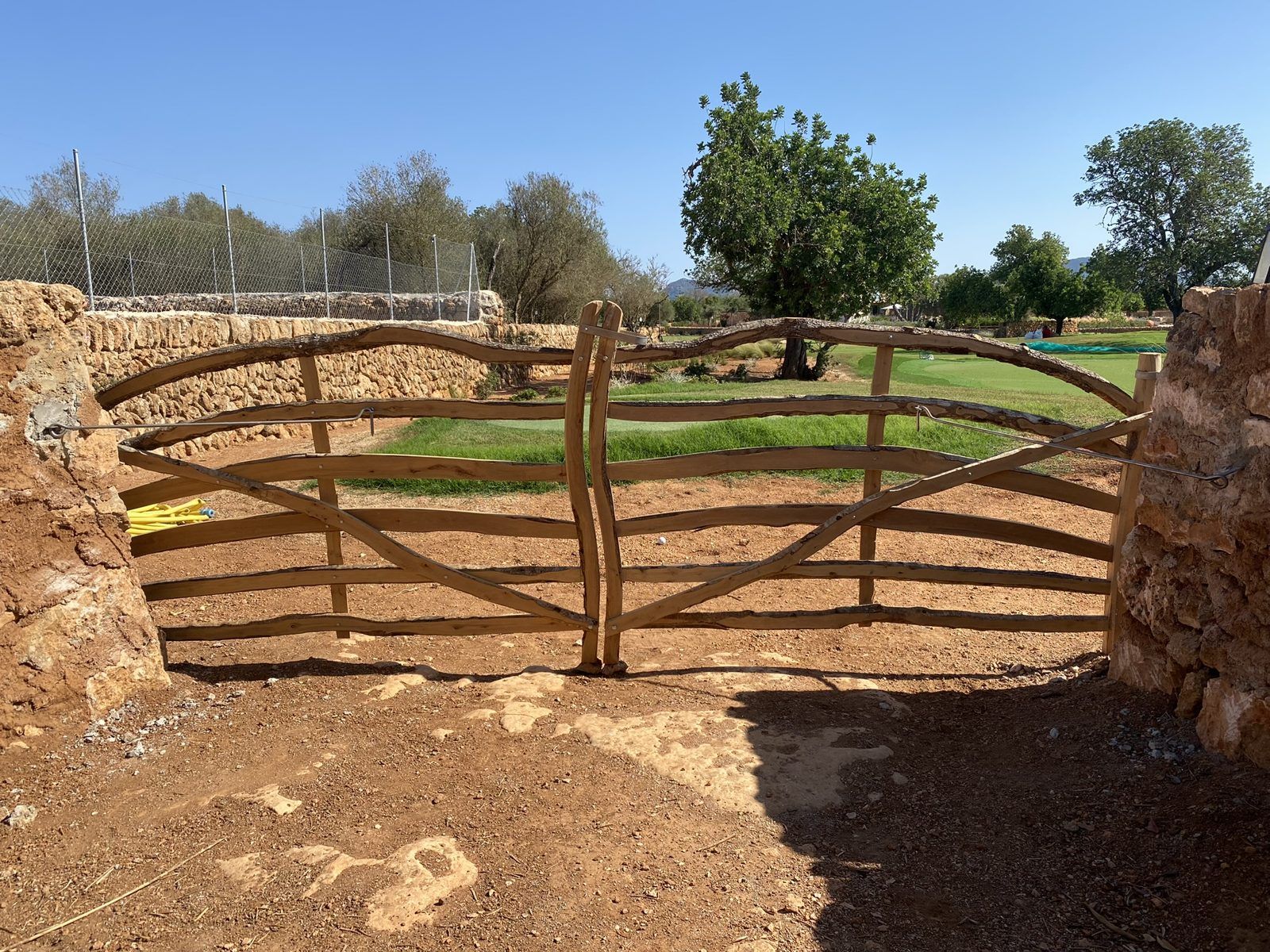
In Menorca, you don’t so much walk the countryside as open and close it. Thousands of kilometres of dry-stone walls carve the island into small fields, the tanques, and in every gap in those walls stands the same pale wooden figure, its curved rails arching like ribs. This is the Menorcan gate, the barrera d'ullastre: a field gate made from the branches of the wild olive which, without ever meaning to, has become one of the most recognisable symbols of the Balearic Islands.
This guide tells its story: where it comes from, what it is made of, who builds it, how to spot a genuine one, and why so humble an object has found its way into gardens, country estates and homes across half the world. I have tried to tell it with rigour; you will find all my sources at the end.
A landscape of stone and wood
To understand the gate, you first have to look at the wall that holds it. The Menorcan countryside is stitched together by a web of dry-stone walls – raised without mortar, stone fitted upon stone – which the local press puts at more than 11,000 kilometres. The earliest known written reference to these walls in Menorca dates from 1345, when King Peter IV authorised landowners to enclose their estates with walls, although the technique is far older and most of what we see today was built between the 18th and 20th centuries. It was above all in the 19th century that the network was completed, at the same time as the old common grazing lands were being enclosed and divided up.
The result is a mosaic: roughly square plots of around a hectare, which Menorcans call tanques. The walls began almost as a by-product – the stones had to be cleared from the fields before they could be farmed – but they ended up serving many purposes at once: marking boundaries, breaking the force of the tramontana wind, holding back erosion, channelling water and, above all, keeping livestock in.
That landscape now enjoys international recognition. In 2018 UNESCO inscribed the ‘Art of dry stone walling, knowledge and techniques’ on the Representative List of the Intangible Cultural Heritage of Humanity, following a joint nomination by eight countries including Spain; Menorca had joined the bid in 2016 and declared the technique an Intangible Asset of Cultural Interest (Bien de Interés Cultural Inmaterial) in 2017. The whole island has also been a Biosphere Reserve since 1993, and in 2023 Talaiotic Menorca was declared a World Heritage Site.
What a gate is for
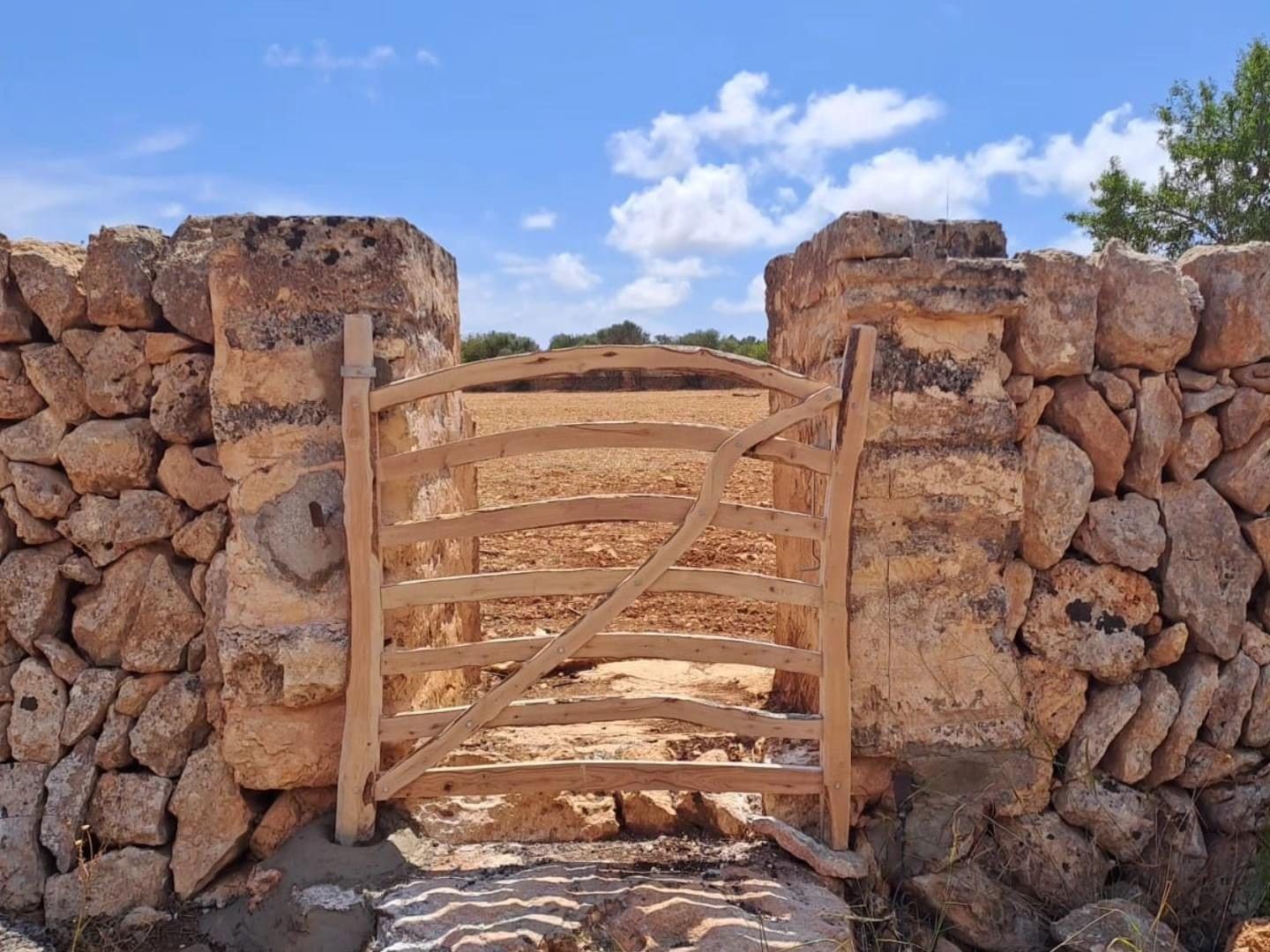
Every wall needs a gap to get in and out: the portell. The gate is the piece that closes it. Its task is at once simple and demanding: to let through people, carts and, later, tractors, while stopping livestock from straying from one tanca to the next or wandering out onto the lane.
For centuries, rural life in Menorca revolved around the lloc or possessió, the traditional farm estate, home to sheep, goats, pigs and, above all, cows. As early as the 15th century, notarial contracts list these animals alongside the obligation to keep the walls in good repair. Over time the dairy cow took centre stage and, with it, one of the island’s great products: its cheese, which has held Designation of Origin status since 1985 – today ‘Mahón-Menorca’. Every gate opened and closed each day was a cog in that machine.
Besides gates, the walls offer another way across on foot: the botadors, stones that jut out from the wall like steps. Using them is now discouraged, since a careless footstep on the wrong stone can bring down a stretch of centuries-old wall.
Ullastre: a wood born to last
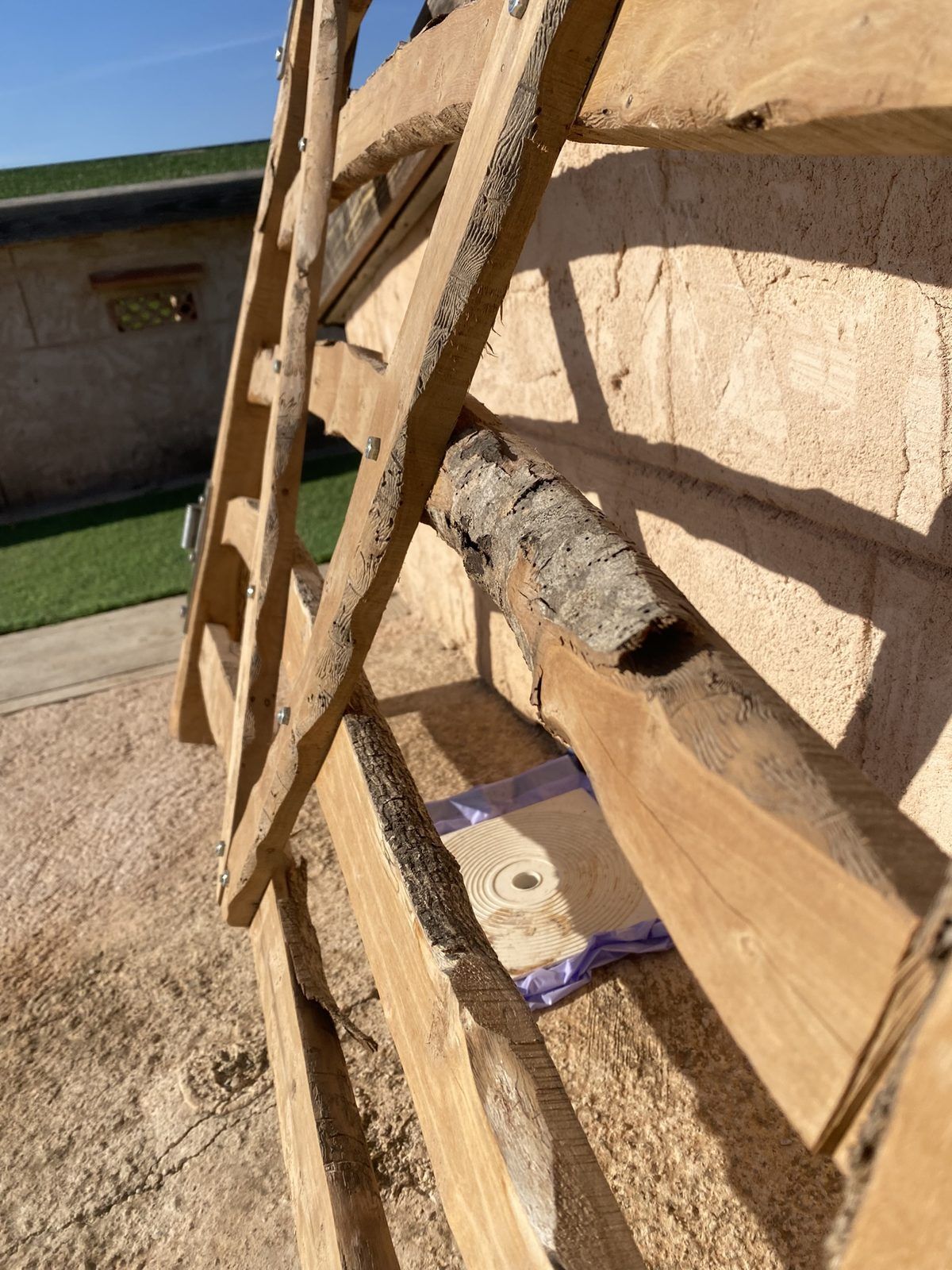
The traditional Menorcan gate is made from ullastre, the wild olive (Olea europaea var. sylvestris), a tree that grows slowly in dry, sunny spots and sprouts back readily after felling or fire. That slowness has its reward: the wood is exceptionally hard, dense and tough, withstands the elements for decades and needs barely any treatment.
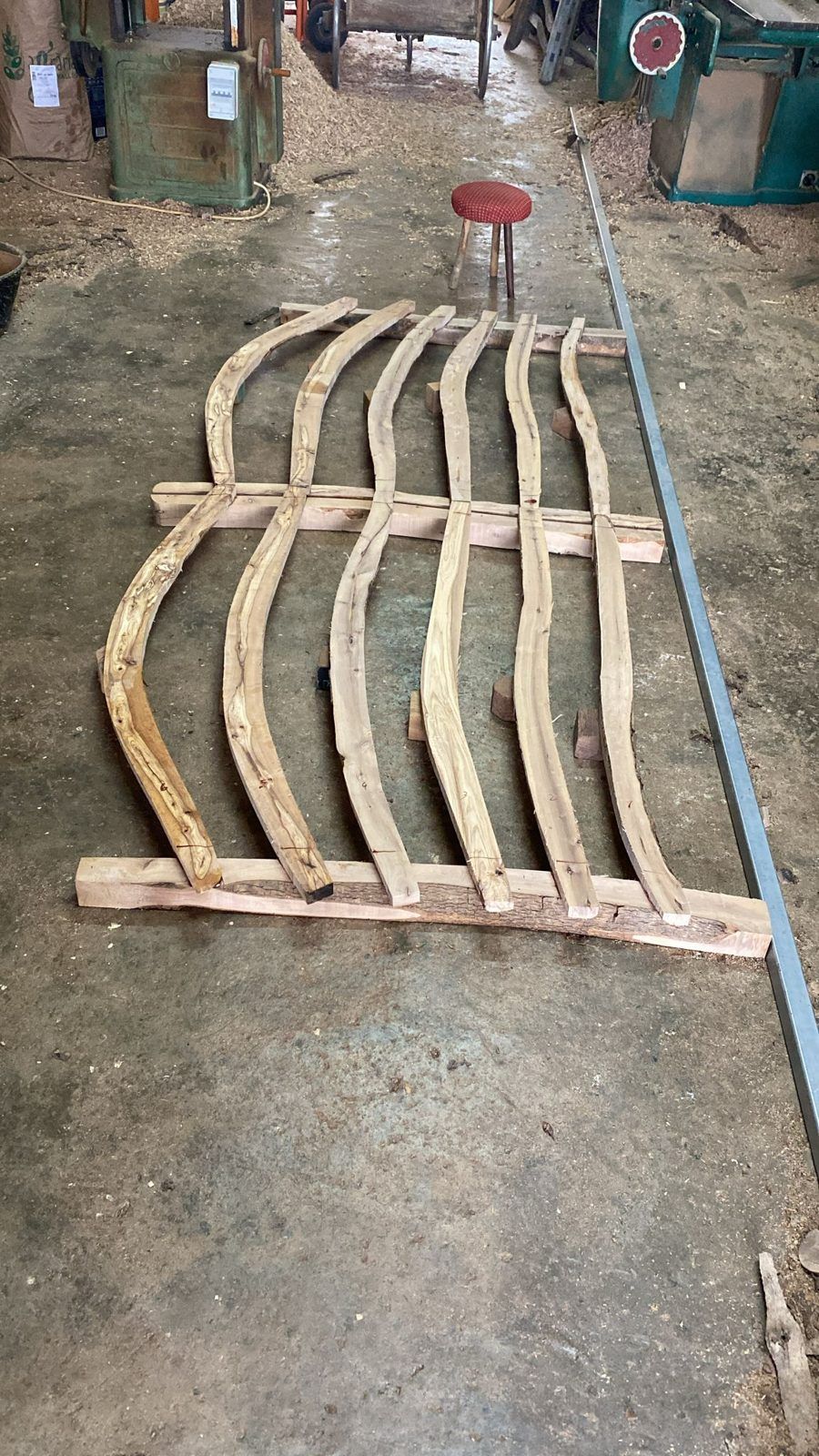
Its great quirk is also its great virtue: the wild olive grows twisted. Where a workshop joiner would see a flaw, the Menorcan craftsman sees a component. The curved branches are used just as they are for the upper rails, which is why no two gates are alike. ‘The most important thing about being an arader is knowing how to choose your wood,’ as one master craftsman from Ciutadella put it to the local press.
Choosing, cutting and seasoning the wood follows rituals handed down by word of mouth. Felling wild olive today requires a permit from the Balearic forestry authority, which specifies the area and the trees that may be cut. Some craftsmen say that ullastre from the north, more battered by the tramontana, is stronger than that from the south, and that the wood should be cut under a waning moon; such lore belongs to the oral tradition that is part and parcel of the craft. Then comes the seasoning, which according to various accounts lasts between one and two years before the gate is assembled. In the past, cheaper pine gates were also made, but ullastre is the hallmark.
The arader, the countryside’s carpenter
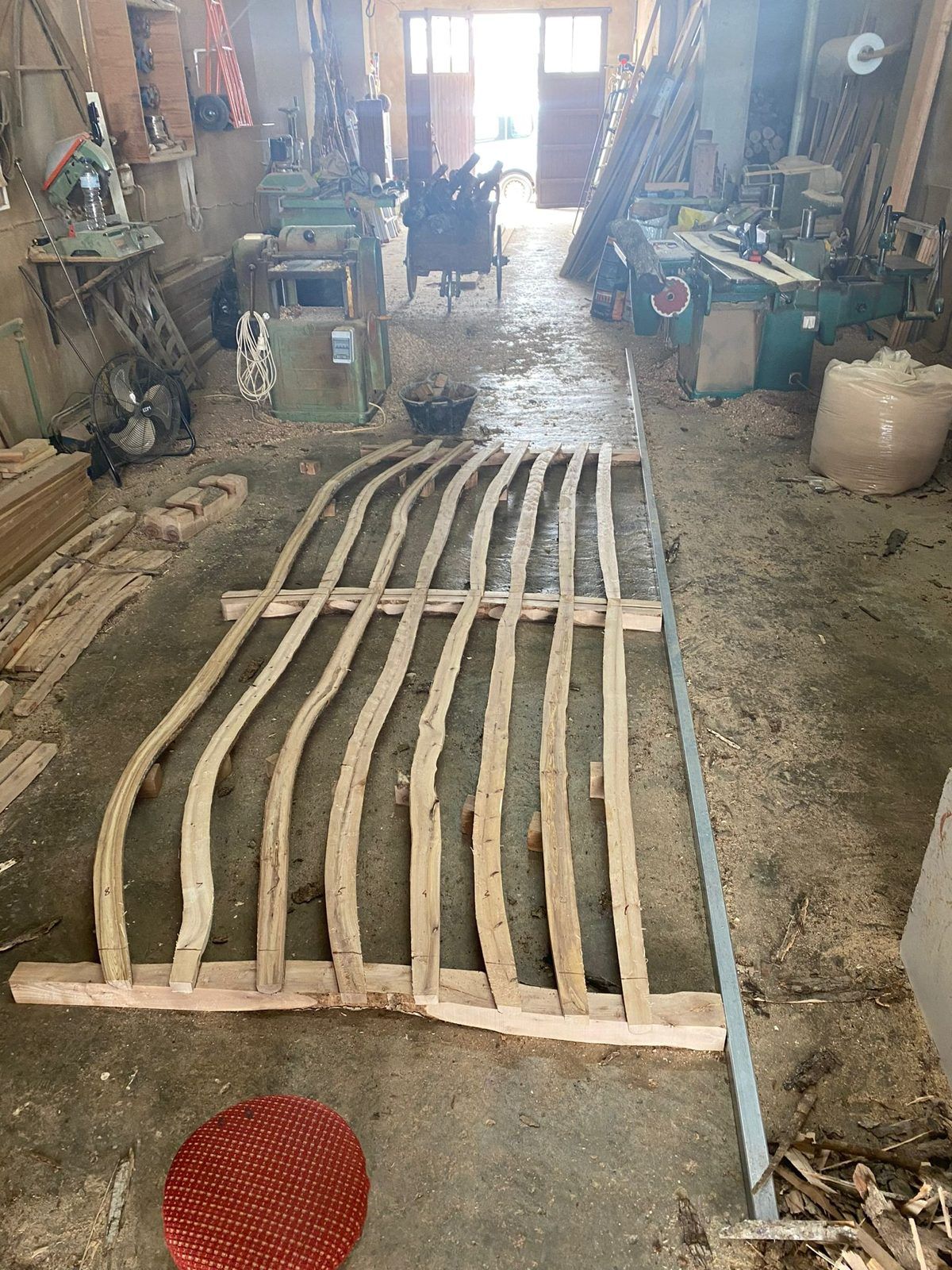
Those who make gates in Menorca go by a name of their own: arader. The word comes from arada, plough, because these rural carpenters made and mended ploughs, carts, tool handles and every kind of farm implement. The gate was just one of their many pieces; in time it became the most famous.
The trade was learnt from father to son or in a master’s workshop. For generations everything was done by hand – with axe, adze, rasp and chisel – and often on the very farm of the countryman who had commissioned the work. Today the workshop has taken on machines, but the important decisions are still made by eye and by hand.
It is also a fragile craft. According to the Menorcan press, in 2024 there were barely five working araders left on the whole island. The trade is listed in Menorca’s Inventory of Intangible Cultural Heritage, and in 2024 the ‘Artesans Araders de Menorca’ received a Diploma of Honour in Madrid from the Official College of Forestry Technical Engineers. Since 2005, the Centre Artesanal de Menorca, in Es Mercadal, has devoted a space to the island’s traditional crafts.
Anatomy of a gate
At first glance they all look alike; up close, each one is different. These are its essential features:
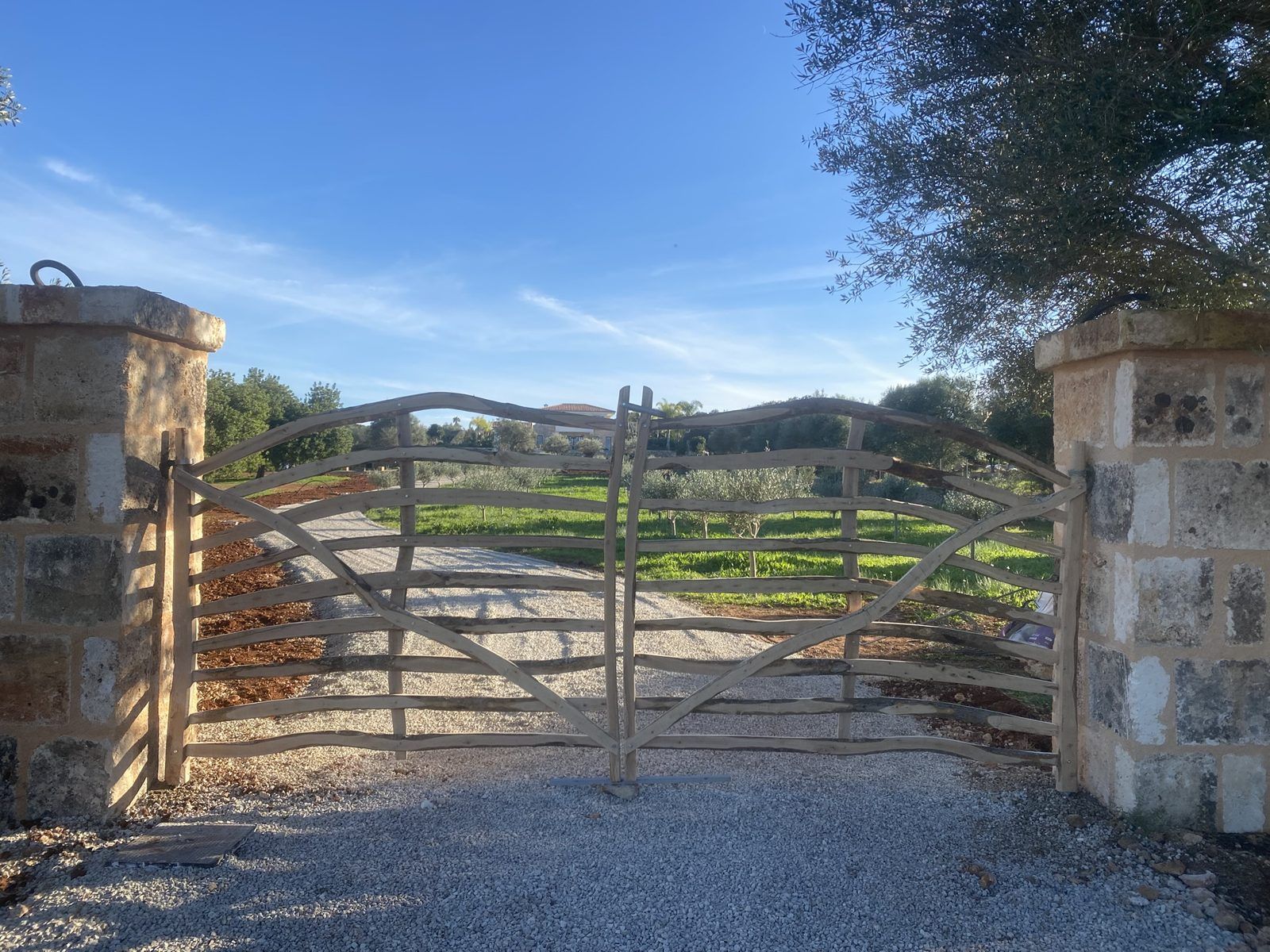
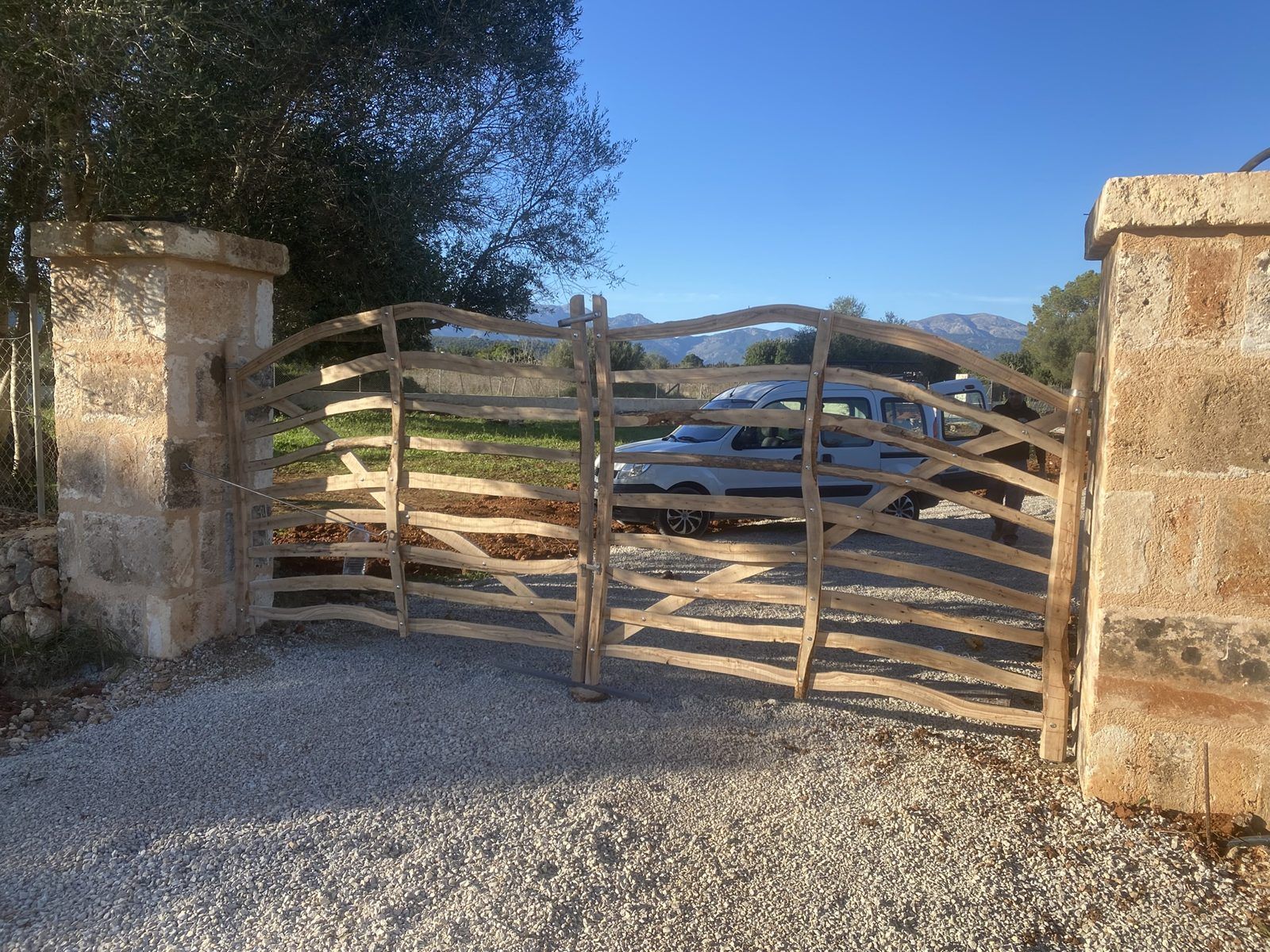
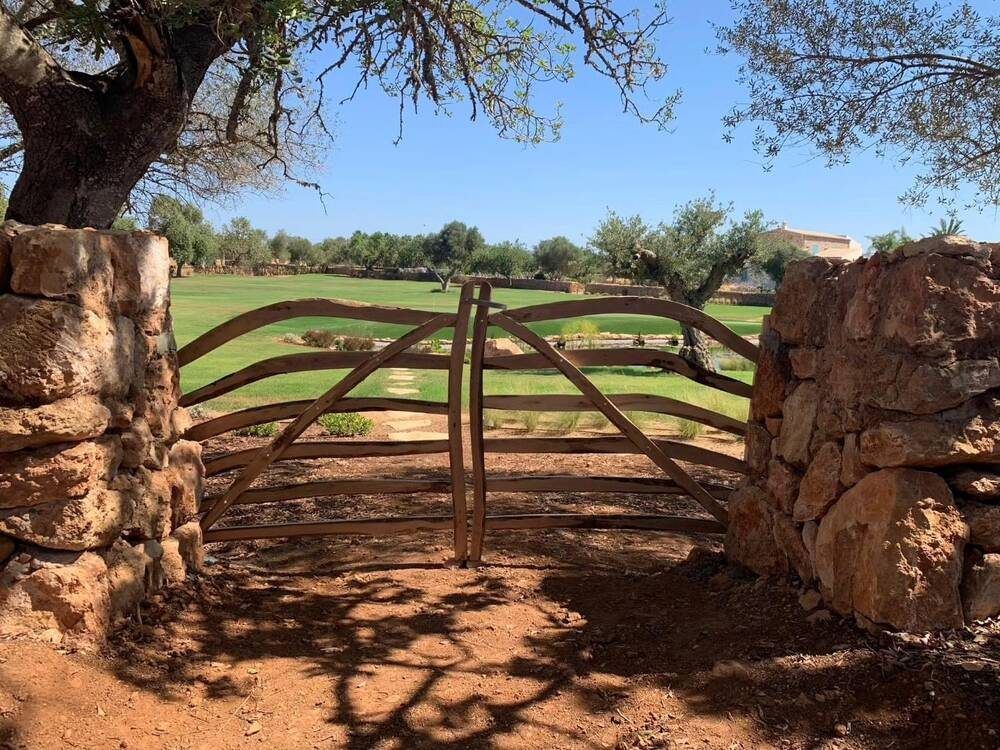
- The horizontal rails. The most detailed sources speak of around eight. The lower ones are set closer together and are straighter, so that small animals can’t slip through; the upper ones spread apart and curve, and they are what give the gate its character.
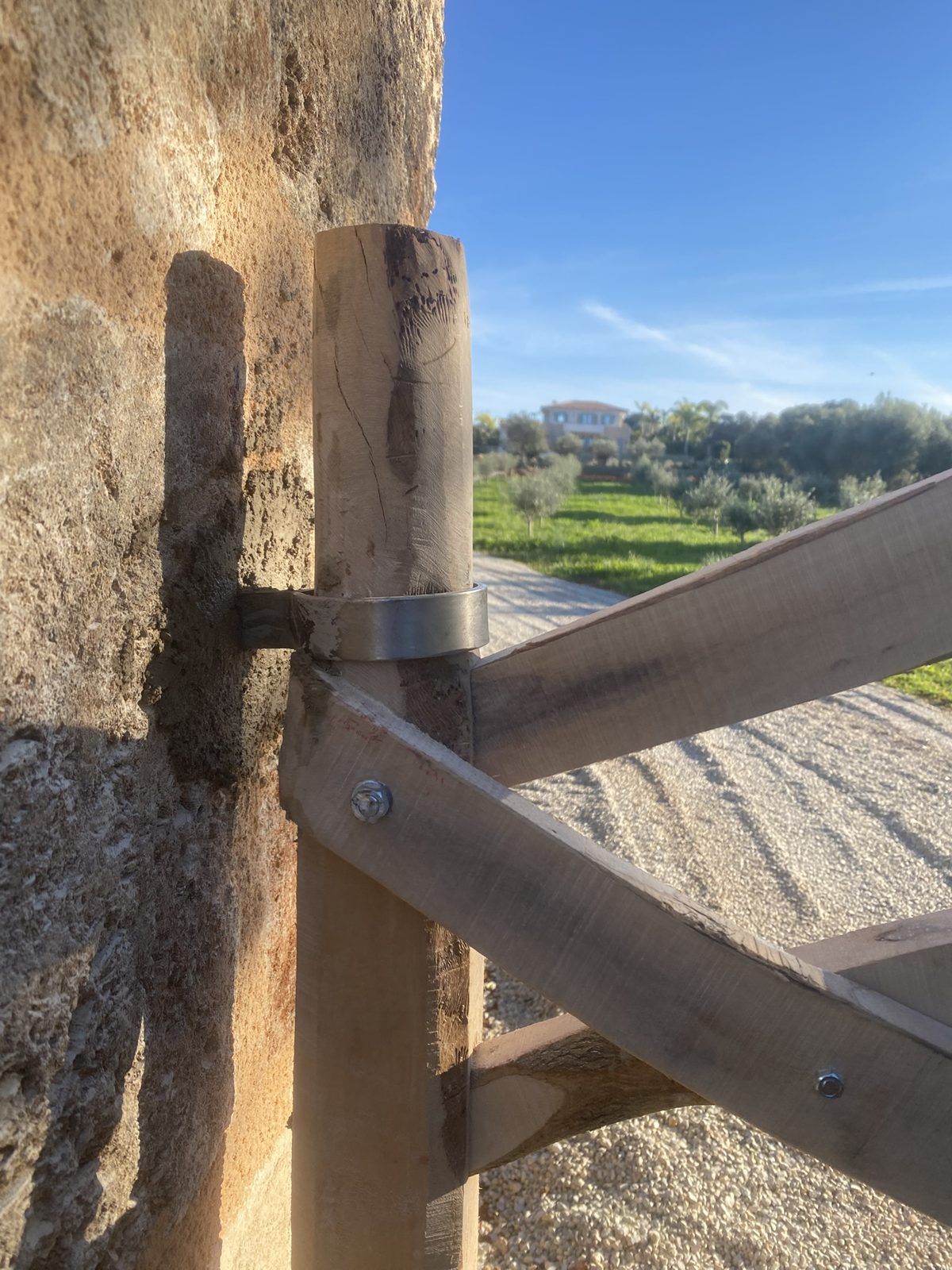
- The vertical stiles, which hold the rails; the one on the hinge side bears almost all the weight.
- The diagonal brace, which stops the gate from sagging over the years.
- The latch: traditionally a wooden bolt, the pestallera, which drops into place by itself as the gate closes.
- Double gates, with two leaves, for wide openings used by carts and tractors.
Traditional assembly uses no glue: the rails are driven into holes and hammered home, so that as the wood moves it tightens the joint. A simple gate can take between twelve and fifteen hours of work; a large one, considerably more. Well made and well hung, it will last twenty, twenty-five, even thirty years out in the open.
On the trail: the Camí de Cavalls
If there is one place where the gate has won fame among travellers, it is the Camí de Cavalls, the old bridleway that circles Menorca along its coast. In the 18th century it had a military purpose – it allowed the coastline to be watched and riders to move between towers and defences – and it was used by farmers too. Today it is the long-distance footpath GR 223: some 185 kilometres divided into 20 stages.
Its revival was the fruit of years of public campaigning. Law 13/2000 declared it open to ‘general, free and unrestricted’ public use, and since 2010 it has been possible to walk it in full. Because it crosses more than a hundred private estates, walkers pass through dozens of wild olive gates that are opened and closed hundreds of times a day. The unwritten rule is sacred: always leave the gate as you found it, because there is usually livestock on the other side.
From field to garden
Paradoxically, what saved the craft was tourism. From the 1970s onwards, the gate began to appear at villas, housing developments and holiday homes, becoming an emblem that is now exported to countries such as France, Germany and the United States. Foreign owners restoring country estates, rural hotels and agritourism retreats choose it because it sums up, in a single piece, everything they seek in the Mediterranean: stone, wood, countryside and craftsmanship.
Its success has also brought problems. The local press has reported thefts of old gates in various parts of the island, and imitations in pine, metal and even PVC have appeared on the market. To protect the landscape, Es Mercadal town council launched grants in 2017 covering up to 70% of the cost of replacing unsightly makeshift barriers – old bed bases, pallets or scrap iron – with wild olive gates.
Today the Menorcan gate can also be found in Mallorca and Ibiza, at estate entrances, on garden paths and around horse paddocks, and the craft has given rise to other pieces too: headboards, banisters, stools and lamps that make use of the same twisted wood.
How to recognise a genuine gate
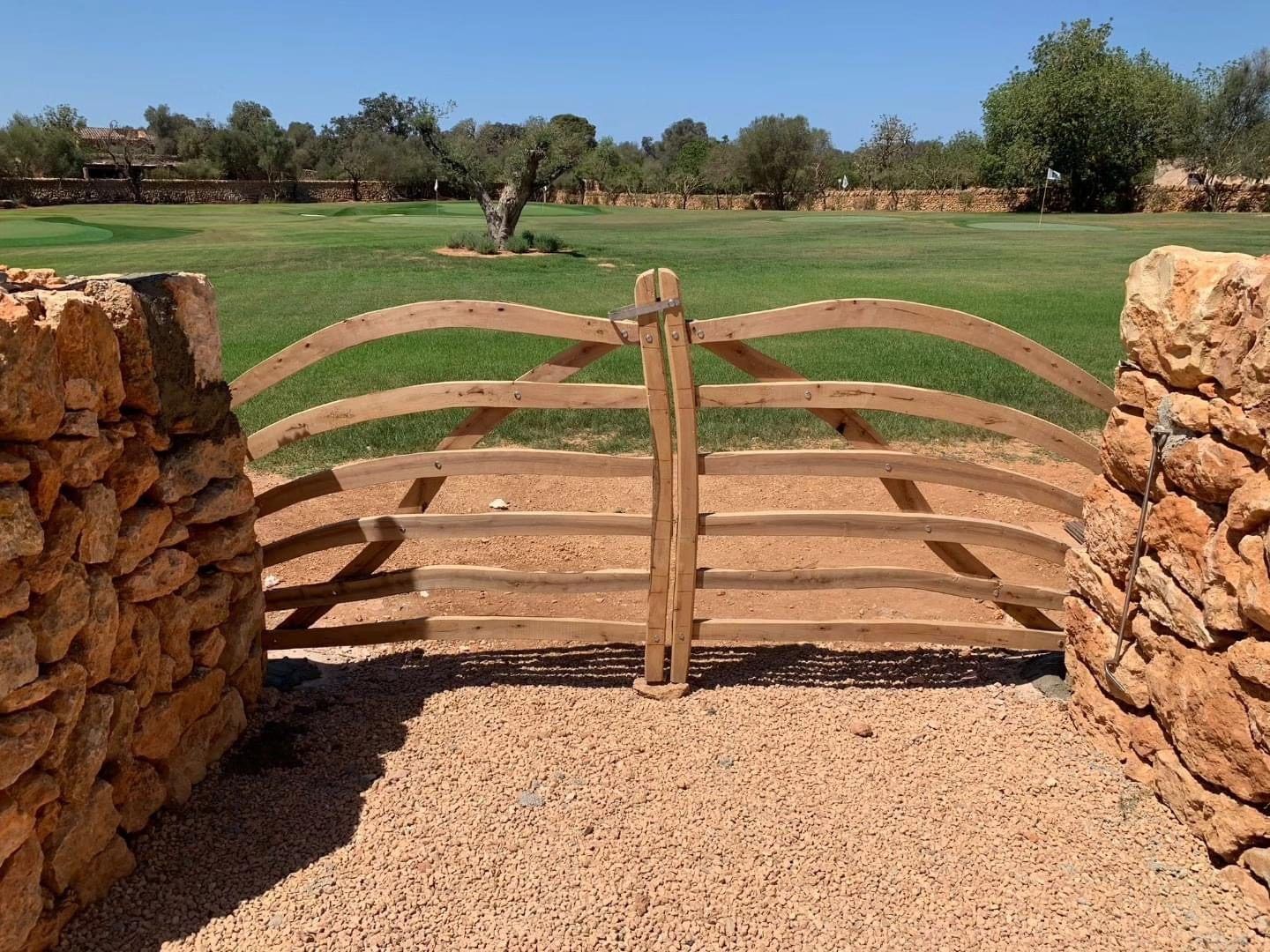
- The wood. Wild olive is very dense, close-grained and honey-coloured when new. Pine is lighter, softer and shows regular knots.
- The curves. On a genuine gate the curves are those of the branch itself: irregular, and different on every rail. Identical curves, whether machined or steam-bent, usually give away an imitation.
- The joints. Tight wooden joints, no glue, and little visible metalwork.
- The weight. An ullastre gate is heavy: it is the simplest test of all.
How to care for it
Tradition says to leave it untreated: with sun and rain, wild olive loses its honey tone and takes on a much-prized silvery-grey patina. Those who would rather keep the colour can apply an exterior wood oil from time to time. Either way, it is worth:
- Checking and greasing the hinges and latches once or twice a year.
- Making sure the bottom of the gate isn’t constantly in contact with damp soil.
- Checking that the pillars are sound: many gates ‘fall down’ because the support gives way, not the wood.
- Repairing in good time: a good arader can replace a damaged piece without rebuilding the whole gate.
A short glossary
- Arader
- Traditional rural carpenter of the Menorcan countryside; makes gates, farm implements and rustic woodwork.
- Ullastre
- Wild olive; the traditional wood of the gate.
- Tanca
- A field enclosed by dry-stone walls (plural tanques).
- Paret seca
- A stone wall built without mortar. The craftsman who builds it is the paredador.
- Portell
- A gap or opening in a wall, where the gate is hung.
- Botador
- Projecting stones that serve as steps for crossing a wall on foot.
- Lloc / possessió
- A traditional Menorcan farm estate.
- Pestallera
- The wooden latch that fastens the gate.
- Camí de Cavalls
- Historic bridleway that circles the island along the coast; today the GR 223 footpath.
Frequently asked questions
What is a Menorcan gate?
It is the traditional field gate of Menorca, made from wild olive wood (ullastre) with curved rails, which closes the openings in dry-stone walls to stop livestock straying from the fields.
What wood is a Menorcan gate made from?
Traditionally ullastre, the wild olive: an extremely hard, tough wood whose curved branches are used for the rails. In the past, cheaper pine gates were also made.
How long does a wild olive gate last?
Well made and well hung, between 20 and 30 years out in the open, according to the craftsmen themselves.
Who makes Menorcan gates?
The araders, the traditional carpenters of the Menorcan countryside. According to the local press, around five were still working on the island in 2024.
Does the wood need treating?
Traditionally, no: wild olive is left natural and takes on a silvery-grey patina. If you want to keep the honey tone, you can apply an exterior wood oil from time to time.
What does it have to do with the Camí de Cavalls?
The Camí de Cavalls (GR 223), some 185 km around Menorca, crosses more than a hundred private estates and dozens of gates. The rule is always to leave them as you found them.
Sources and bibliography
Facts checked against the following sources. Oral traditions (the moon phase for felling, differences between northern and southern wild olive) are recorded as the testimony of the craftsmen.
- IPCIME – Inventari del Patrimoni Cultural Immaterial de Menorca: el paredador — www.ipcime.es
- IPCIME – El ofici d'arader — www.ipcime.cat
- UNESCO – Art of dry stone walling, knowledge and techniques (decisión 13.COM 10.B.10, 2018) — ich.unesco.org
- Consell Insular de Menorca – Menorca, multidesignación UNESCO (Reserva de Biosfera 1993, Menorca Talayótica 2023) — menorcatalayotica.info
- Tomàs Vidal Bendito, «El paisatge rural de l'illa de Menorca», Revista de Geografia (1998) — raco.cat
- Carlos Seguí Puntas, «Ses Amitges (Societat Rural Menorquina)», Revista de Menorca — raco.cat
- El Iris – «Arader, un ofici tradicional en supervivència» (2024) — www.eliris.cat
- Menorca.info – «El més important per fer d'arader és saber triar la llenya» (2011) — www.menorca.info
- Menorca.info – Barreras de acebuche, objetivo de ladrones (2022) — www.menorca.info
- Menorca.info – Es Mercadal y las ayudas a las barreras de acebuche (2019) — www.menorca.info
- Menorca.info – SOS paret seca (2024) — www.menorca.info
- Última Hora – Entrevista a un arader de Es Mercadal (2023) — www.ultimahora.es
- Colegio Oficial de Ingenieros Técnicos Forestales – Diploma de Honor a los Artesans Araders de Menorca (2024) — www.forestales.net
- Govern de les Illes Balears – Xarxa Forestal: Olea europaea (ullastre) — www.caib.es
- Camí de Cavalls 360 – The arader's hand on the paths of Menorca — www.camidecavalls360.com
- Wikipedia – GR 223 (Camí de Cavalls) — es.wikipedia.org
- Wikipedia – Barrera menorquina — es.wikipedia.org
- Illes Balears Travel – Centre Artesanal de Menorca — www.illesbalears.travel
- Documentales Etnográficos – «L'arader» — www.documentalesetnograficos.es
Would you like a Menorcan gate for your finca?
We order each gate from a craftsman in Menorca, handmade in wild olive to fit your opening. We collect it, deliver it and install it in Mallorca and across the Balearics.